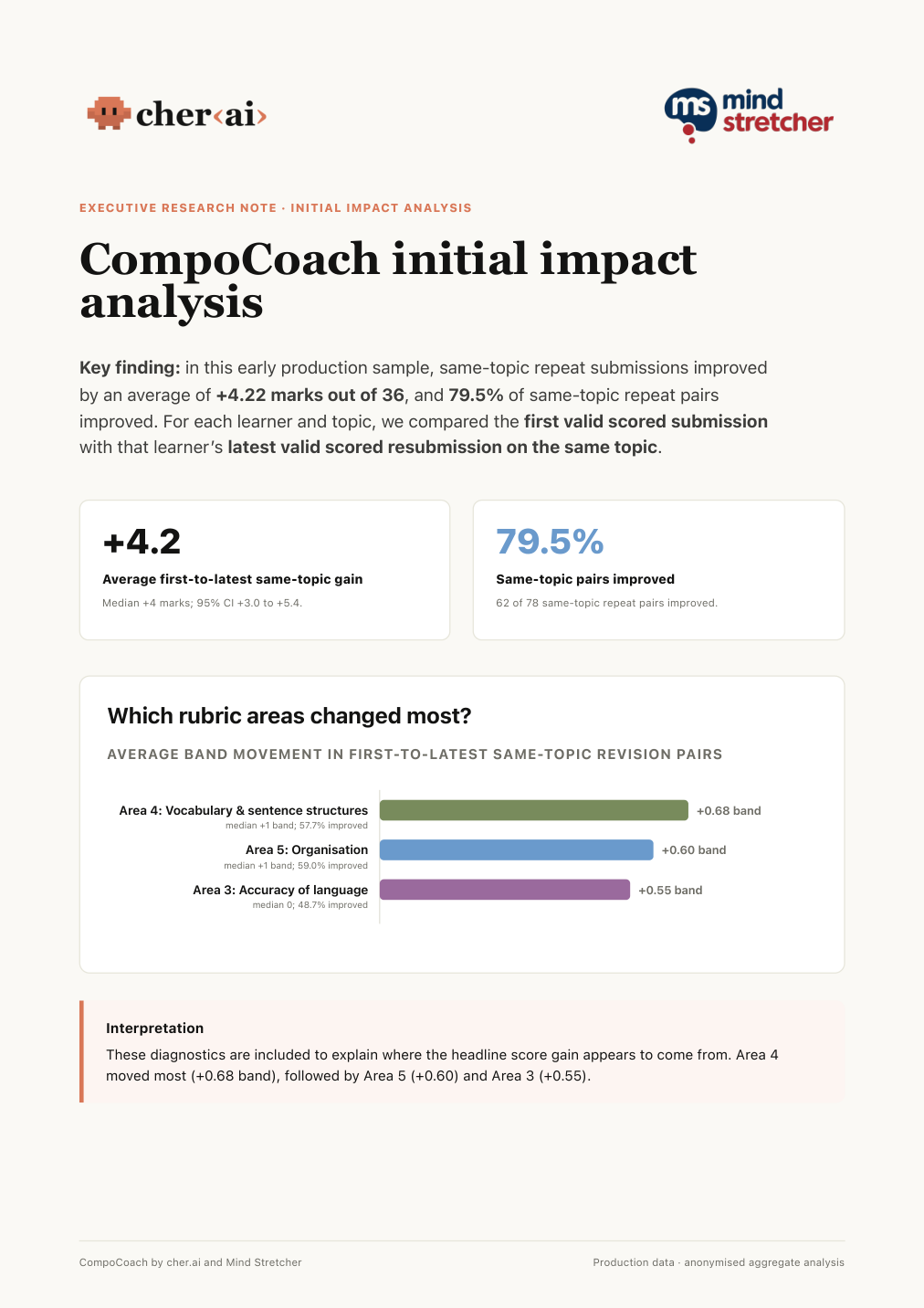
Key finding: in this early production sample, same-topic repeat submissions improved by an average of +4.22 marks out of 36, and 79.5% of same-topic repeat pairs improved.
For each learner and topic, we compared the first valid scored submission with that learner's latest valid scored resubmission on the same topic. Same-topic repeats are the strongest early production signal because they likely represent students revising after feedback.
Which rubric areas changed most?
How broad was the improvement?
This distribution is same-topic only: the first-to-latest score change for a student on the same normalised topic.
Method. Production CompoCoach data from 2 May to 5 June 2026 UTC: 483 valid scored learner submissions, with staff, editor and test accounts excluded. Scores are from the same grading model.
Why same-topic revisions matter. They are the closest available proxy for feedback-driven revision: the learner returns to a similar writing task after receiving feedback.
Caveat. This is observational production evidence, not a randomised causal study. The evidence supports the narrower claim that repeat same-topic usage shows meaningful score and rubric movement.