1. Learn
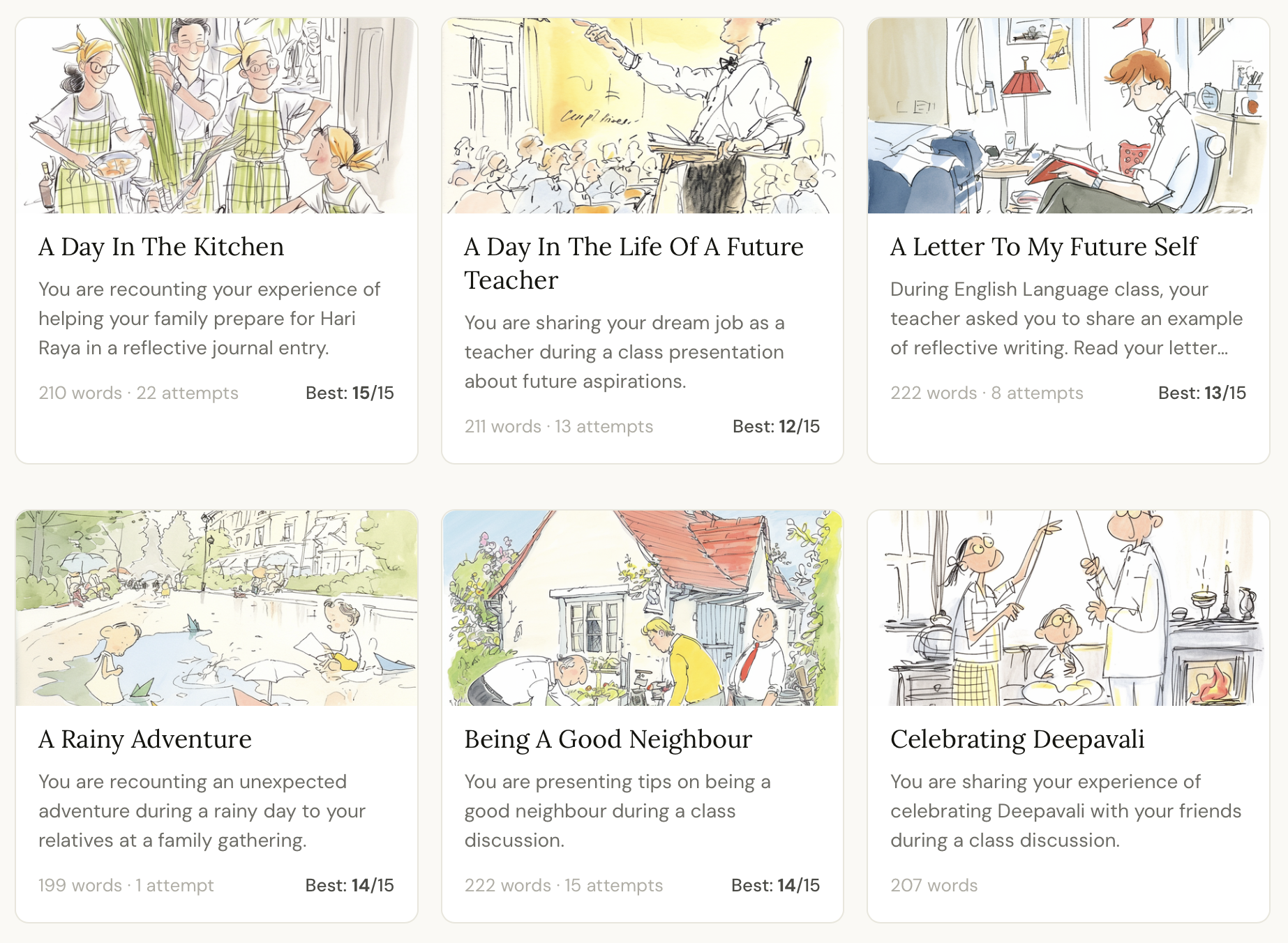
40 SpeakSmart audio exercises that demonstrate how to read clearly and expressively. See what is possible, not just what's passable. Learn how great speakers use their voices to bring passages to life.
Expert-level reading aloud feedback and practice for PSLE. See what's possible, not just what's passable, with your voice.
A complete toolkit to help students ace the PSLE reading aloud component
40 SpeakSmart audio exercises that demonstrate how to read clearly and expressively. See what is possible, not just what's passable. Learn how great speakers use their voices to bring passages to life.
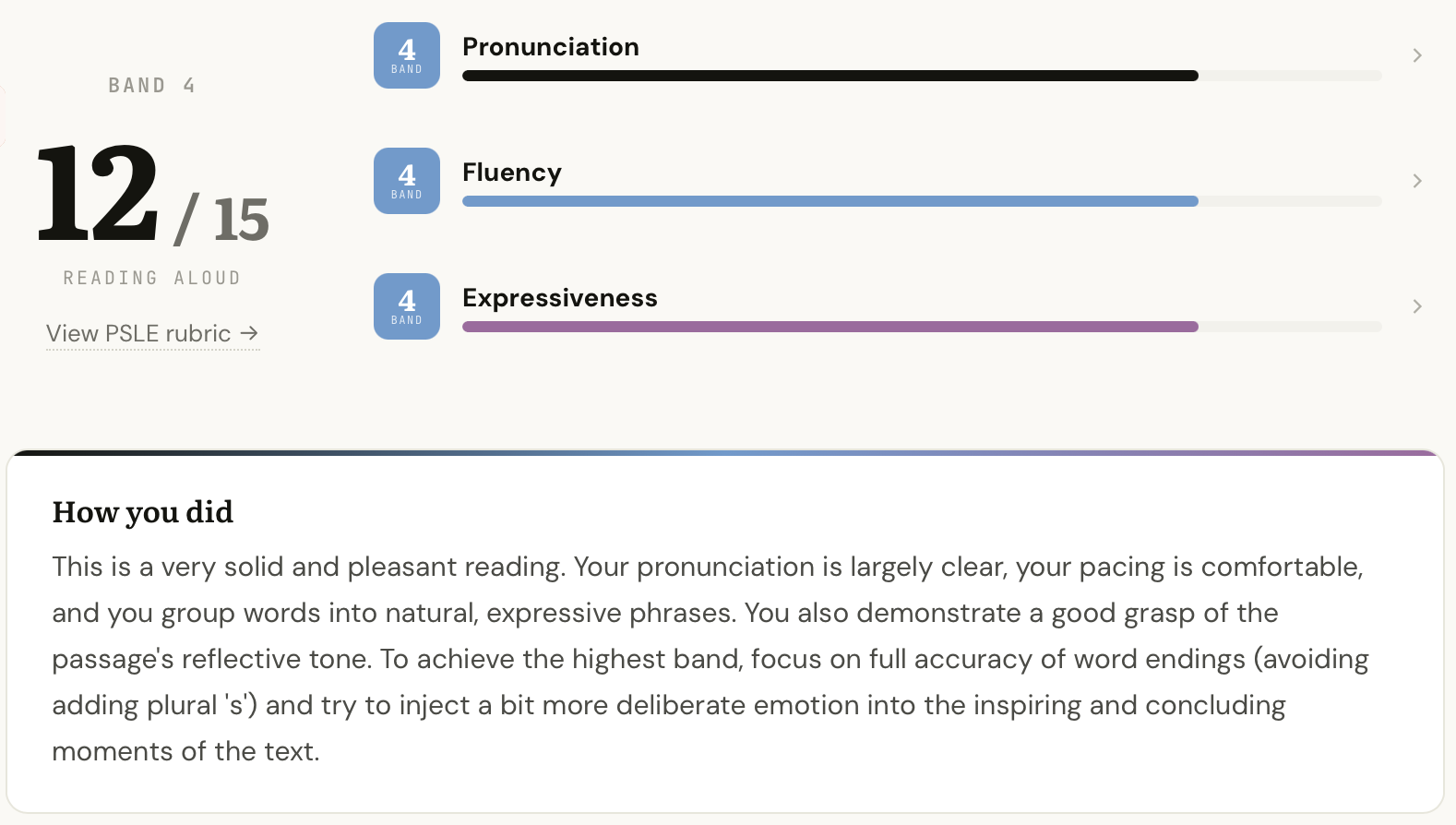
Practise and get your estimated PSLE reading aloud score, as well as detailed pronunciation, fluency and expressiveness feedback, by using our Reading Aloud assessment. This uses the most advanced AI models to deliver fair, calibrated feedback with concrete steps for improvement.
Join us for Mind Stretcher's popular oral mastery workshops on Luma, where we share practical strategies and proven frameworks for improving your oral communication. See our previous sessions on Reading Aloud and Stimulus-based Conversation.
Each exercise gives students a model to hear, notes to study, and exam-ready practice they can return to until expressive reading feels natural.
Curated, high-quality recordings demonstrating expressive reading techniques.
Explanations of tone, pace, emphasis, and inflections to create different effects.
Scenarios and passages designed in line with the 2025 PSLE English syllabus.
Pointers from teachers who have helped thousands of students level up their oral communication skills.
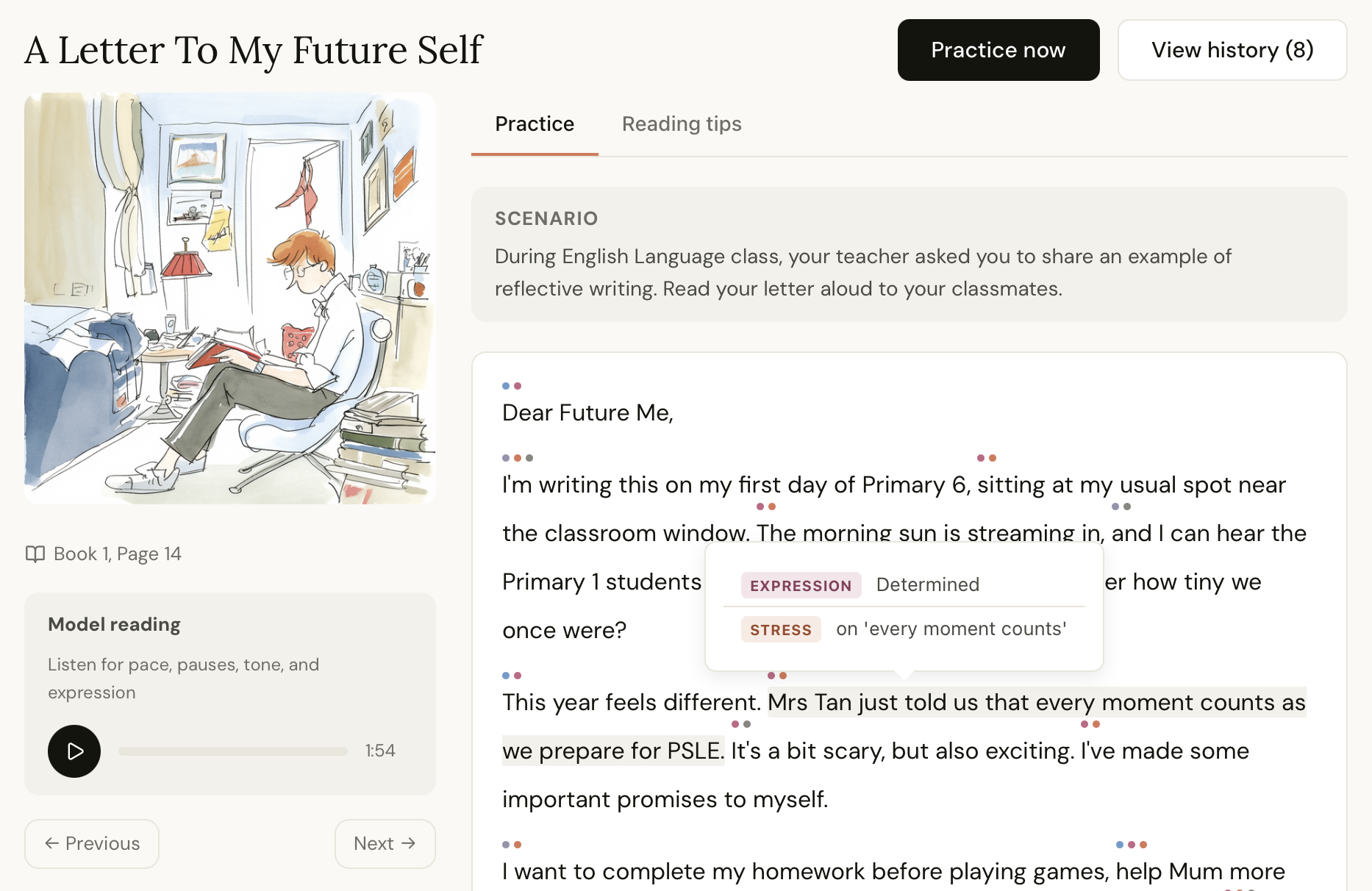
Here is one example of how students can study a model reading, then practise with guided notes.
Read the passage, then use the model reading and notes to shape pace, tone, and emphasis.
Do all of you ever wonder what makes a neighbourhood truly feel like home? Well, let me tell you. It’s not just the houses or parks – it’s the people.
Being a good neighbour may seem simple, but it has a big impact on those around us. Last week, I helped my elderly neighbour, Madam Ling, carry her groceries upstairs. "Thank you," she said with a warm smile. "I don’t know what I would’ve done without your help." That small moment reminded me how even tiny actions can make a difference.
Being considerate – like keeping noise levels down, returning borrowed items or even just greeting your neighbours – goes a long way. I once borrowed a ladder and returned it with a thank-you note. My neighbour, Mr Rajoo, smiled and said, "Come over anytime!"
Communities thrive when we look out for one another. Whether it’s organising a block party, sharing tools or simply saying 'hello,' these acts build trust and create a sense of belonging.
So, what’s the lesson here for all of us?
Being a good neighbour doesn’t take much – just a little kindness, a bit of effort and maybe a ladder or two! Let’s all do our part to make our neighbourhoods friendlier and more fun for everyone.
I hope you find these small tips of mine useful!
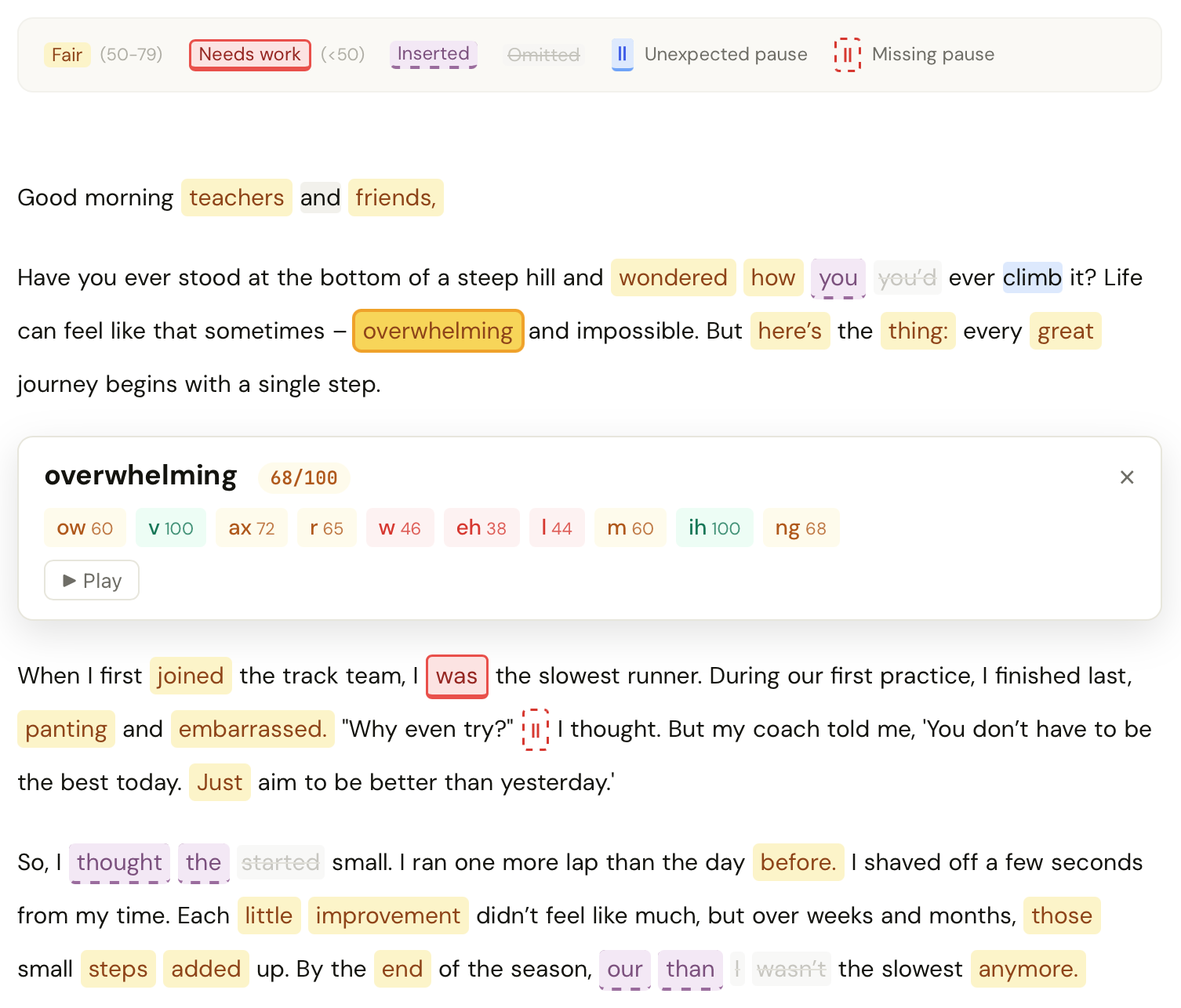
We use the leading audio models to detect misread or mispronounced words, as well as common Singaporean issues like swallowed ending 'd's (e.g. in "made"), truncated digraphs like three vs tree, and show you exactly which part of the word was not pronounced clearly.
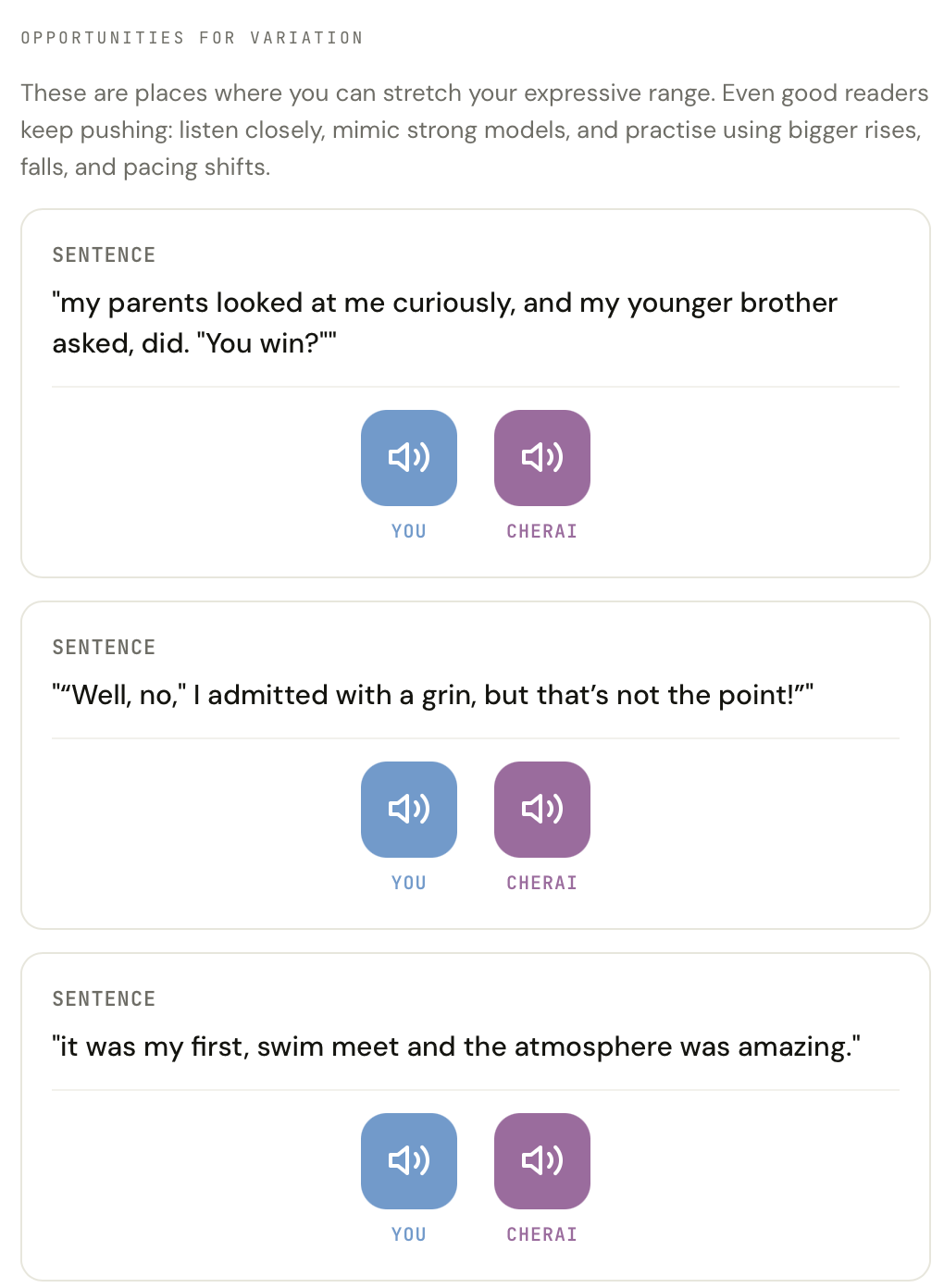
Enough of being told to "speak more expressively". We use advanced AI models to detect opportunities to incorporate variation in pitch and tone, and then deliver a side-by-side comparison of a student's speech & an expressively read snippet from our SpeakSmart models.
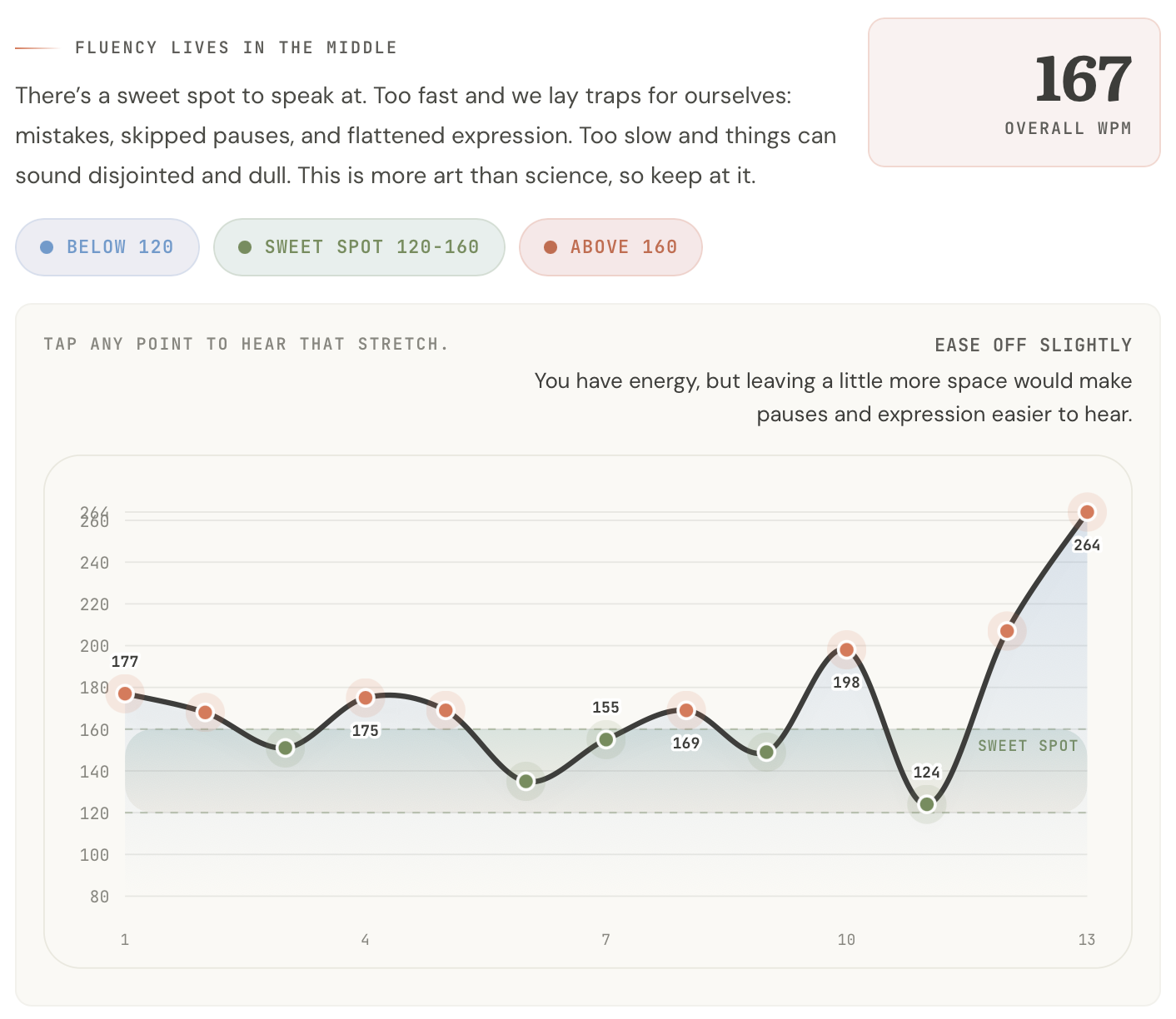
Many students lose marks by speaking too fast, which leads to mistakes, rushed delivery, and a lack of expression. We measure a student's reading speed through their recordings, and show when they are outside the sweet spot. We also detect missing pauses, as well as unnatural pauses.
We don't just give written feedback. Students can replay exactly the parts of the clip where they did well and where they could improve, so they can hear what they did, make adjustments, and improve quickly. And we put all the feedback together in a detailed annotated transcript.
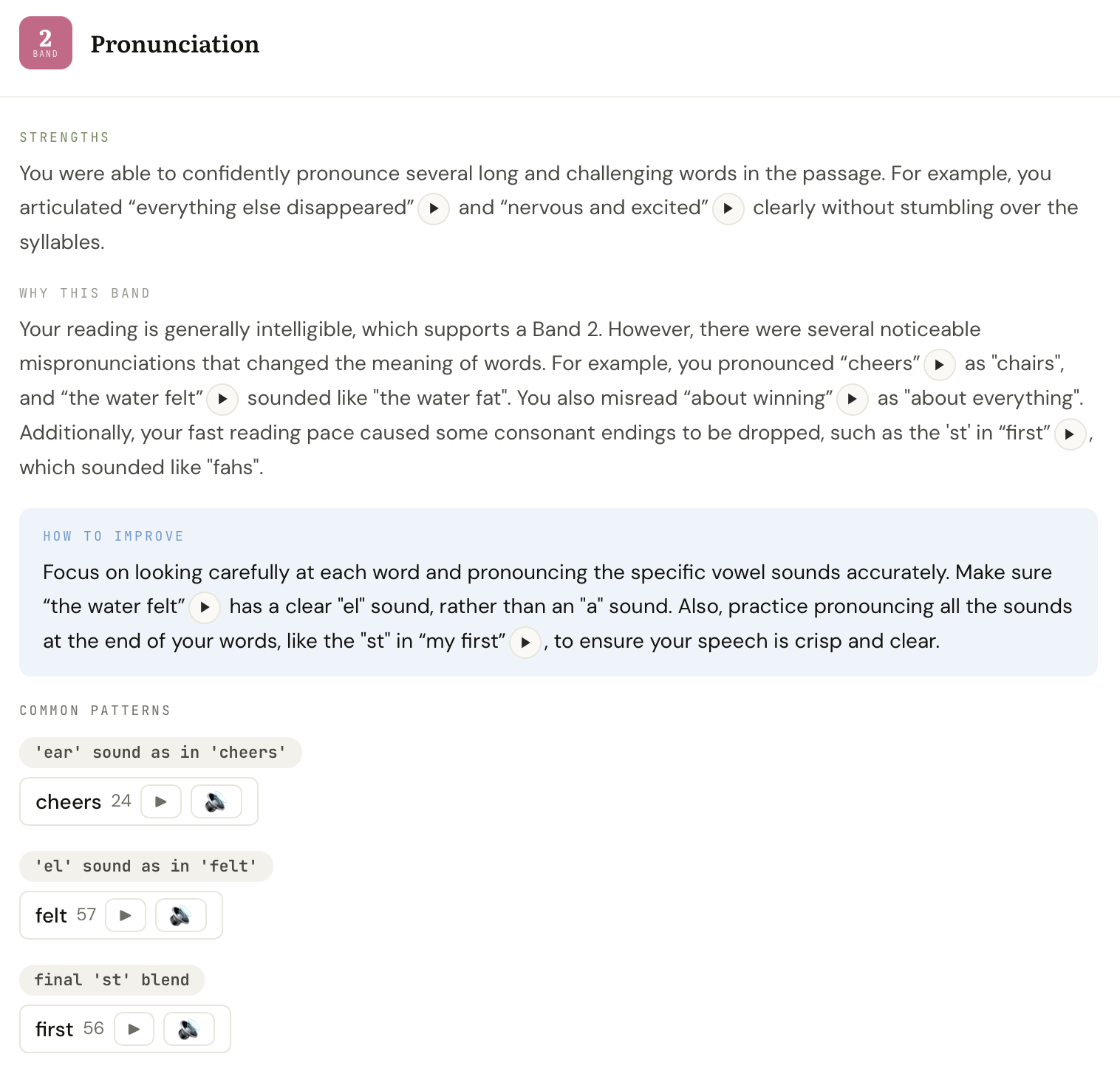
Reading Aloud is based on the revised 2025 PSLE English Reading Aloud rubrics, including the core skills of pronunciation, fluency, and expressiveness. Read more about the rubrics.
Raw output from the speech analyser. Some flags may be machine artefacts (softened final consonants, accent variation, unusual word forms) rather than real pronunciation issues — that's why they aren't all in the list of sounds to practise above.
There’s a sweet spot to speak at. Too fast and we lay traps for ourselves: mistakes, skipped pauses, and flattened expression. Too slow and things can sound disjointed and dull. This is more art than science, so keep at it.
These are places where you can stretch your expressive range. Even good readers keep pushing: listen closely, mimic strong models, and practise using bigger rises, falls, and pacing shifts.
Good morning everyone!
Joining a CCA c a is more than just an after-school school activity || – is it's a journey || of discovery and growth. For me, that journey began when I joined the drama club. At first, I was hesitant. "I don't think I'm good at acting," I told my friend Sarah when she encouraged me to join.
"Everyone starts somewhere," she said. || "You just need to try!"
Our first major project was a school play. I started with a small role, but soon realized that every member of the team was essential || to the final performance. From learning my lines to helping with props, I discovered the value of teamwork and creativity.
The real challenge came when our lead actor fell sick just two days before the performance play. "We need someone to step in," Mrs. || Siti, our Drama teacher, said, looking at me. "Can you do it?" I hesitated, but finally agreed.
With support from my teammates, I learned the lines and delivered the performance. When the curtains closed, the applause was unforgettable! Being part of my CCA c a helped me grow as a person, and I made friendships that will last a lifetime. It showed me || how stepping out of my comfort zone can unlock talents I never knew I had. I hope all of you will find your CCA c a fulfilling too!
Thank you.
Raw output from the speech analyser. Some flags may be machine artefacts (softened final consonants, accent variation, unusual word forms) rather than real pronunciation issues — that's why they aren't all in the list of sounds to practise above.
There’s a sweet spot to speak at. Too fast and we lay traps for ourselves: mistakes, skipped pauses, and flattened expression. Too slow and things can sound disjointed and dull. This is more art than science, so keep at it.
These are places where you can stretch your expressive range. Even good readers keep pushing: listen closely, mimic strong models, and practise using bigger rises, falls, and pacing shifts.
Yesterday, I spent the entire day helping my family prepare for Hari Raya. The house was filled with excitement and the delicious smell of traditional dishes being cooked.
My first task was to help my mother make ketupat. She showed me how to weave the leaves into neat little pouches. “Not like that,” she said, laughing as I struggled. It took a few tries, and my first ketupat looked more like a tangled mess. “You’re getting better,” Mum encouraged, and after some guidance, I finally got the hang of it.
Next, I helped my aunt prepare rendang. The kitchen was busy as everyone chopped onions, blended spices and stirred the pot.
“Be careful with the spices!” my aunt warned as I added the chilli paste. The rich, fragrant aroma of the simmering beef made my mouth water.
My cousins and I also helped bake the Hari Raya cakes. Rolling the dough and adding the finishing touches was messy but so much fun.
When we finally sat down together to enjoy the meal, I felt so proud seeing how everyone’s efforts came together. Helping with the preparations reminded me that Hari Raya is about more than just the food – it’s about family, gratitude and the joy of celebrating traditions together.
Ready to practise
Start with Reading Aloud and see your estimated PSLE score, pronunciation feedback, fluency notes, and expressiveness coaching in one report.
Our assessment is organised around the same skills students are expected to demonstrate in the PSLE oral exam: clear pronunciation, fluent pacing with sensible pauses, and effective variation in pitch and tone.
| Band | Marks | Descriptors |
|---|---|---|
| 5 | 13–15 |
|
| 4 | 10–12 |
|
| 3 | 7–9 |
|
| 2 | 4–6 |
|
| 1 | 1–3 |
|
Source: Singapore Examinations and Assessment Board / Ministry of Education, PSLE English Language oral examination, 2025 revised syllabus.
Why we built this
Oral communication is now 20% of PSLE English scores, and rightly so. It is probably one of the most important skills a child should develop in school.
But practice has always been difficult and expensive. Oral communication is one area where 1-1 feedback is the only practical way to improve. Even then, it is challenging to give great, actionable feedback.
We built Reading Aloud in partnership with Mind Stretcher and Master Speakers to help students practise and improve quickly. Over the years, we have taught thousands of students to ace their PSLE exam, and under Master Speakers, we have coached many of Singapore's leading public-speaking champions. We know the common issues, and we know how to help students build skill quickly.
Reading Aloud puts an expert-level reading aloud tutor within reach of every student. The best students use it to practise daily. I'm looking forward to seeing how good you'll get.


Moses Soh
2012 President's Scholar, creator of Cher.ai