cherai

CompoCoach

Expert-calibrated PSLE composition feedback, rewrites, and model compositions whenever your child is ready to practise.

How we help

An expert-level grader and writer within reach of every student

Detailed feedback by rubric section

Today, students generally get an overall mark and some comments for each composition they write. CompoCoach goes in-depth into every section of the official PSLE continuous writing rubric.

We incorporate positive marking by recognising what students have done well, explaining why they are in the band, and giving actionable examples of how to improve.

Real rewrites, not surface-level feedback

Writing improves when students can see concrete, inspiring examples of how their writing can be transformed, not when they are given vague, general feedback.

CompoCoach rewrites paragraphs to improve plot relevance, showcase greater sentence structure variety and vocabulary, and more.

Catch common but subtle errors that affect marks

CompoCoach is trained as an expert-level tutor. It spots subtle plot problems, such as deus ex machina, catches logical leaps, identifies phrasal verb issues and dialogue errors, and ensures students understand and can avoid these mistakes.

Expert-teacher calibration

Grades are accurate and aligned to what experienced teachers give, with an error range of plus or minus one mark.

We do this by constantly calibrating our marking against the team of curriculum specialists at Mind Stretcher, comprising ex-Heads of Department who have marked thousands of compositions over the years.

Fantastic model compositions for study

Mind Stretcher's A*Star writing books are among the most popular study resources in Singapore for continuous writing, because the model essays are interesting, fun for students to read, and use accessible yet powerful techniques to make writing come alive.

CompoCoach now gives students an A*Star-quality composition for any topic, with detailed annotations to highlight techniques used, a vocabulary and technique bank, and simple plots that are easy to execute under time pressure.

A*Star model compositions

Interesting, accessible essays that incorporate practical techniques for improving writing scores and inspire students to reach higher.

Each model composition uses practical techniques from the Mind-Stretching Writing Toolkit developed by

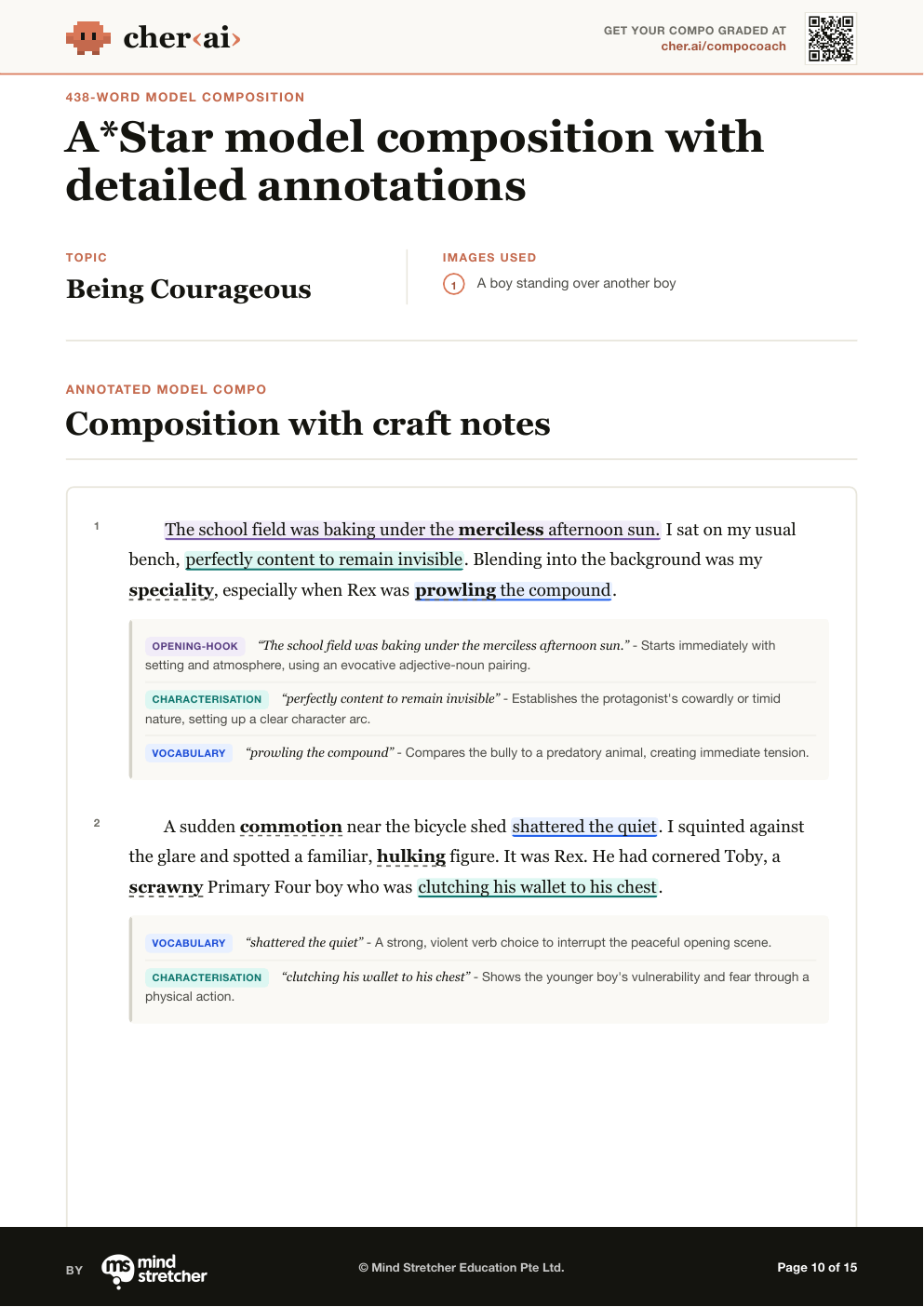
Full annotated model composition

1

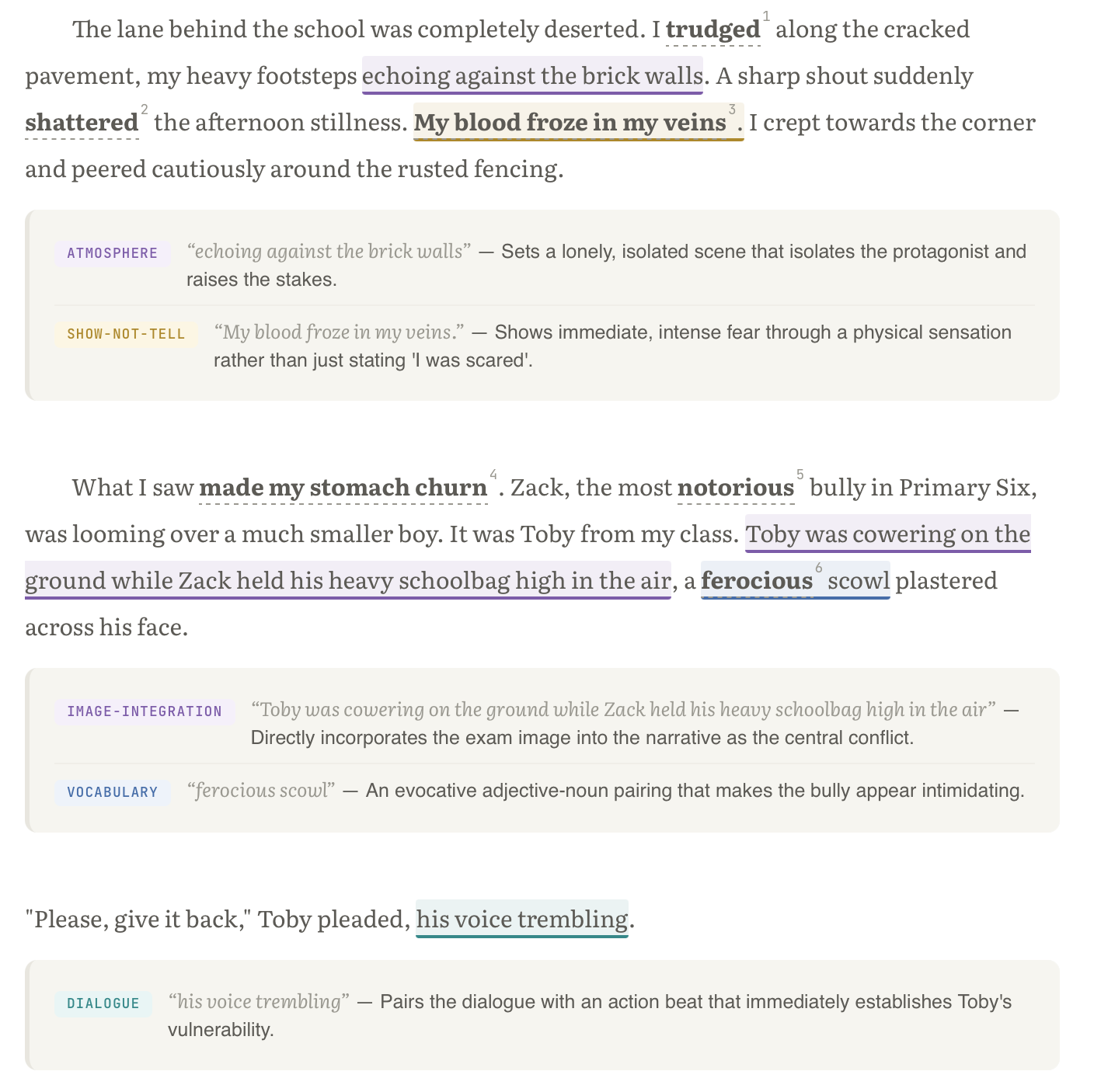
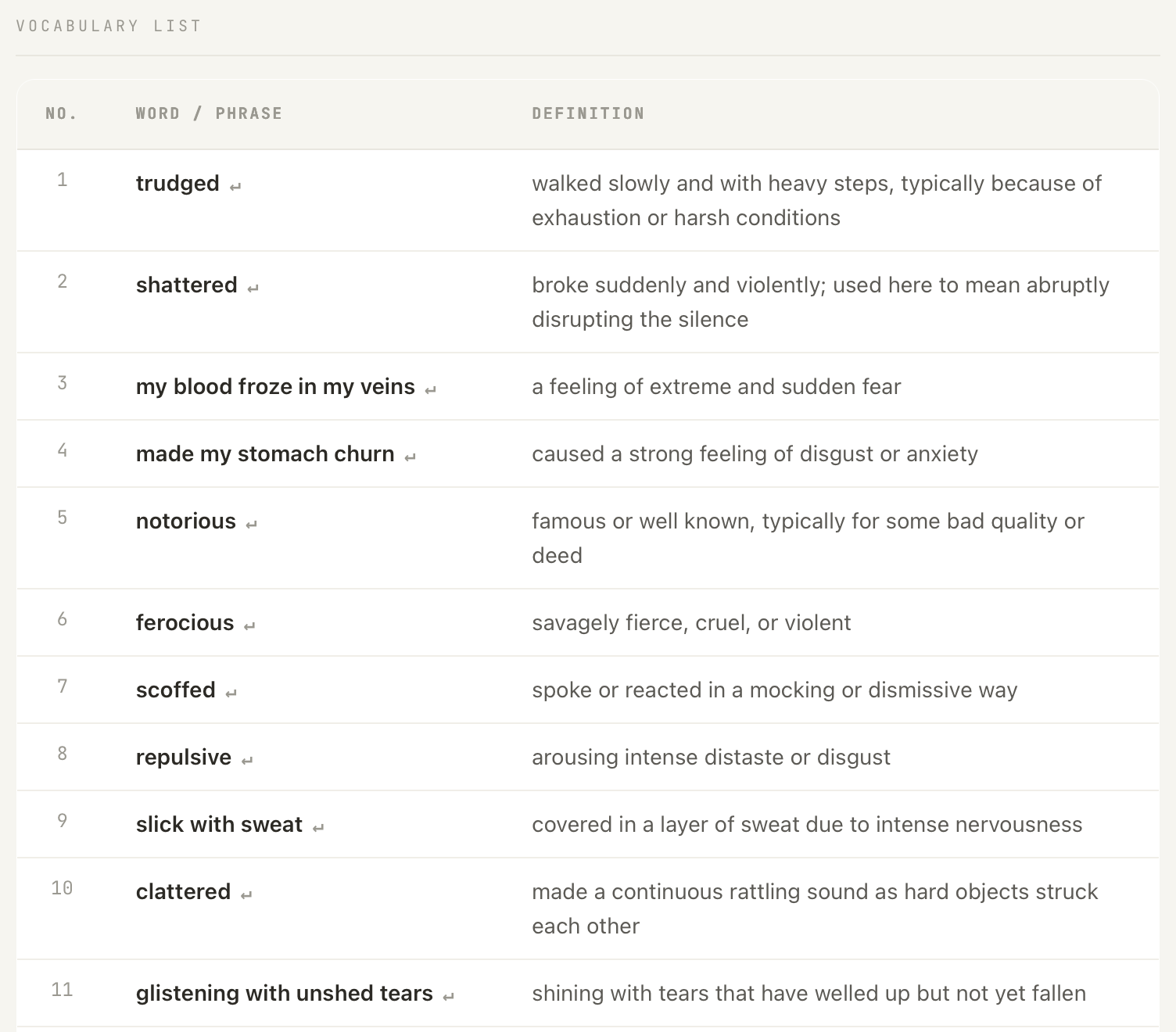
The school field was baking under the merciless1 afternoon sun. I sat on my usual bench, perfectly content to remain invisible. Blending into the background was my speciality2, especially when Rex was prowling3 the compound.

opening-hook “The school field was baking under the merciless afternoon sun.”Starts immediately with setting and atmosphere, using an evocative adjective-noun pairing.
characterisation “perfectly content to remain invisible”Establishes the protagonist's cowardly or timid nature, setting up a clear character arc.
vocabulary “prowling the compound”Compares the bully to a predatory animal, creating immediate tension.
2

A sudden commotion4 near the bicycle shed shattered the quiet. I squinted against the glare and spotted a familiar, hulking5 figure. It was Rex. He had cornered Toby, a scrawny6 Primary Four boy who was clutching his wallet to his chest.

vocabulary “shattered the quiet”A strong, violent verb choice to interrupt the peaceful opening scene.
characterisation “clutching his wallet to his chest”Shows the younger boy's vulnerability and fear through a physical action.
3

My stomach tied itself into a tight knot7.

dramatic-short “My stomach tied itself into a tight knot.”A short paragraph dedicated to a single physical sensation, marking the shift from observation to personal distress.
show-not-tell “My stomach tied itself into a tight knot.”Shows fear physically rather than simply stating 'I was afraid'.
4

Every instinct screamed at me to look away. If I interfered, I would become his next target. I gathered my bag, ready to slink8 back to the safety of the classroom. Then, Rex shoved Toby hard. The younger boy stumbled backwards, his hands flailing, before hitting the rough concrete with a sickening thud9.

tension “ready to slink back to the safety of the classroom”Shows the protagonist's internal conflict and initial choice to be a bystander, making his eventual intervention more impactful.
vocabulary “sickening thud”An evocative sensory pairing that makes the violence feel visceral and real.
5

Rex loomed10 over the fallen boy, his face contorted into a ferocious scowl11. He jabbed a thick finger at Toby.

image-integration “Rex loomed over the fallen boy”Directly incorporates the exam image of a boy standing over another, using it as the catalyst for the protagonist's intervention.
vocabulary “contorted into a ferocious scowl”Vivid physical description that escalates the threat level.
6

"Hand it over, before I make you," Rex snarled, his voice dripping with malice12.

dialogue “"Hand it over, before I make you," Rex snarled”Uses a strong dialogue tag to convey aggression.
literary-device “dripping with malice”A metaphor that makes the threat feel heavy, wet, and poisonous.
7

Toby was trembling like a leaf in the wind13, tears welling in his eyes. Seeing him so helpless sparked something unexpected inside me. The fear was still there, but indignation14 flared hotter. My legs moved before my brain could stop them. I sprinted across the concrete and forced myself between the two of them.

literary-device “trembling like a leaf in the wind”A simile that emphasises Toby's extreme physical fear and fragility.
characterisation “The fear was still there, but indignation flared hotter.”Bridges the emotional shift. The protagonist does not magically stop being afraid; his anger at the injustice simply outweighs his fear.
8

"Leave him alone," I demanded.

dialogue “"Leave him alone," I demanded.”A direct, simple line of dialogue that marks the protagonist's point of no return.
9

My voice cracked, betraying my terror, but I planted my feet firmly. Rex blinked, clearly taken aback by this sudden intrusion. He sized me up, his fists clenching and unclenching. My palms were slick with sweat. I could feel my pulse drumming in my ears15, deafeningly loud. I braced myself for the inevitable blow.

show-not-tell “My voice cracked, betraying my terror”Reveals fear through an involuntary physical reaction (voice cracking) despite the brave action.
show-not-tell “pulse drumming in my ears, deafeningly loud”A metaphor for a racing heart that puts the reader inside the protagonist's panicked sensory experience.
10

"Are you going to be a problem, Leo?" he sneered, taking half a step forward.

dialogue “"Are you going to be a problem, Leo?"”Rex's dialogue is manipulative and challenging, escalating the tension before the resolution.
11

I did not flinch. Instead, I stared straight into his eyes and raised my chin. A few passing students had stopped, their eyes fixed on the unfolding drama. Sensing the growing audience, Rex scoffed loudly. He muttered a string of insults under his breath, spun on his heel16, and stalked off17 towards the canteen.

characterisation “stared straight into his eyes and raised my chin”A physical gesture of defiance that contrasts completely with the boy who wanted to be invisible in paragraph one.
tension “Sensing the growing audience, Rex scoffed loudly.”Provides a logical reason for the bully to back down, keeping the plot realistic.
12

The breath I had been holding rushed out of me, and my shoulders sagged. My legs wobbled dangerously as the adrenaline drained away. I turned to Toby and offered him a hand, pulling him up from the unforgiving ground18. He brushed the dust off his uniform and mumbled a quick word of thanks.

show-not-tell “The breath I had been holding rushed out of me, and my shoulders sagged.”Shows immense relief physically. The tension leaves the character's body.
literary-device “unforgiving ground”Personification of the concrete, subtly highlighting the harshness of the situation Toby was in.
13

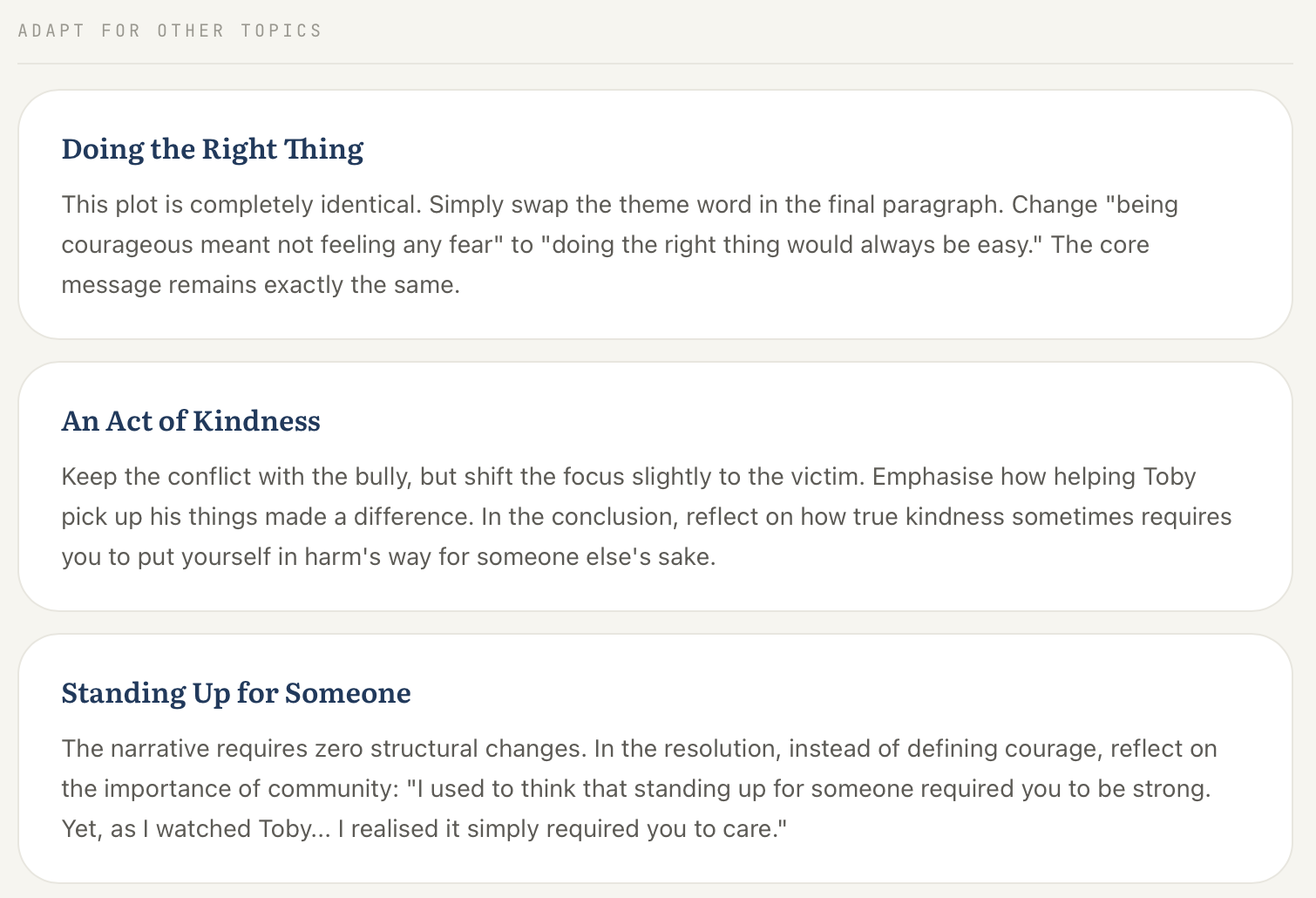
As we walked back to the classroom together, I realised something important. Being courageous did not mean being unafraid. It meant feeling completely terrified, yet choosing to do the right thing anyway.

resolution “It meant feeling completely terrified, yet choosing to do the right thing anyway.”A mature, unpretentious reflection that perfectly defines the theme based on the actions just shown.
theme-word “Being courageous did not mean being unafraid.”Integrates the exact theme word into the concluding thoughts naturally.

Ready to practise

Get your next composition graded by CompoCoach.

Start with CompoCoach and see the mark, feedback, rewrites, and A*Star-style model answer in one report.

Try CompoCoach now

Why we built this

Writing improvement is bottlenecked by feedback

Students need regular writing practice to improve, but practice only works when the feedback is specific enough to act on.

That is the hard part. A strong teacher can easily spend 30 minutes or more marking one composition properly: reading the plot carefully, checking relevance, diagnosing language issues, explaining the mark, and showing how the writing could be improved. At national scale, that level of feedback is difficult to give often.

We built CompoCoach so a motivated student does not have to wait weeks to find out how to improve. Every composition gets expert-calibrated grading, concrete feedback, paragraph rewrites, and a model composition the student can study.

The goal is simple: put an expert-level grader and model composition writer in every student's hands, so students can practise, study and improve as fast as they are willing to work.

Moses Soh signature
Moses Soh

Moses Soh

2012 President's Scholar, creator of Cher.ai

See a full CompoCoach report

Choose a sample to view grading notes, annotated writing, and a model composition.

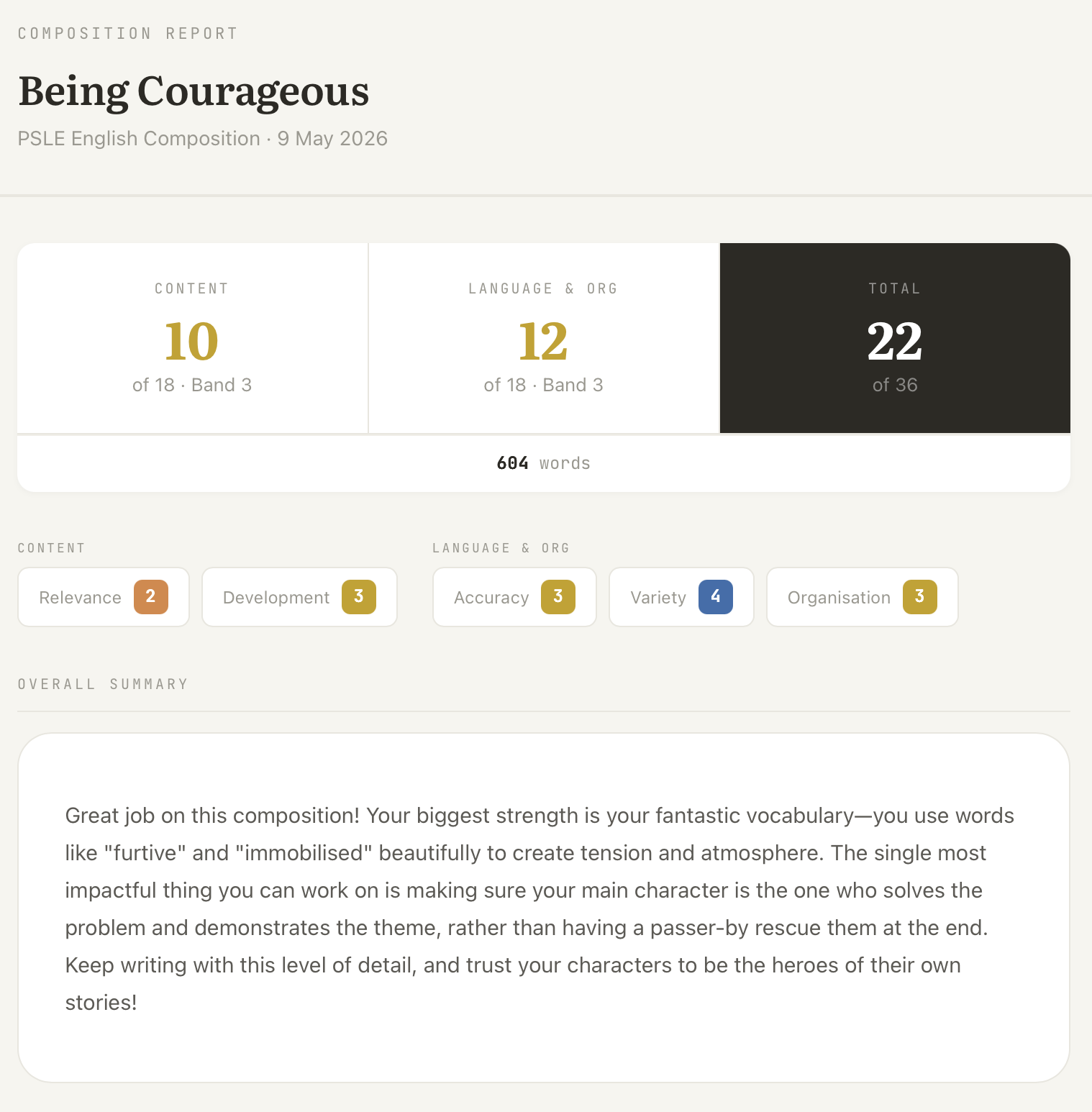
Composition Report

Being Courageous

PSLE English Composition
Content
10
of 18 · Band 3
Language & Org
14
of 18 · Band 4
Total
24
of 36
604 words
Content
Relevance 2
Development 3
Language & Org
Accuracy 4
Variety 4
Organisation 3

You have a wonderful command of vocabulary and you clearly know how to set up an engaging, high-stakes conflict! The single most impactful change you can make is to ensure your main character drives the theme of the story, rather than relying on a passer-by to save the day. When the topic is "Being Courageous," let your protagonist be the one to show courage and solve the problem, even if they are terrified while doing it. Keep up the fantastic effort—your descriptive writing is a joy to read!

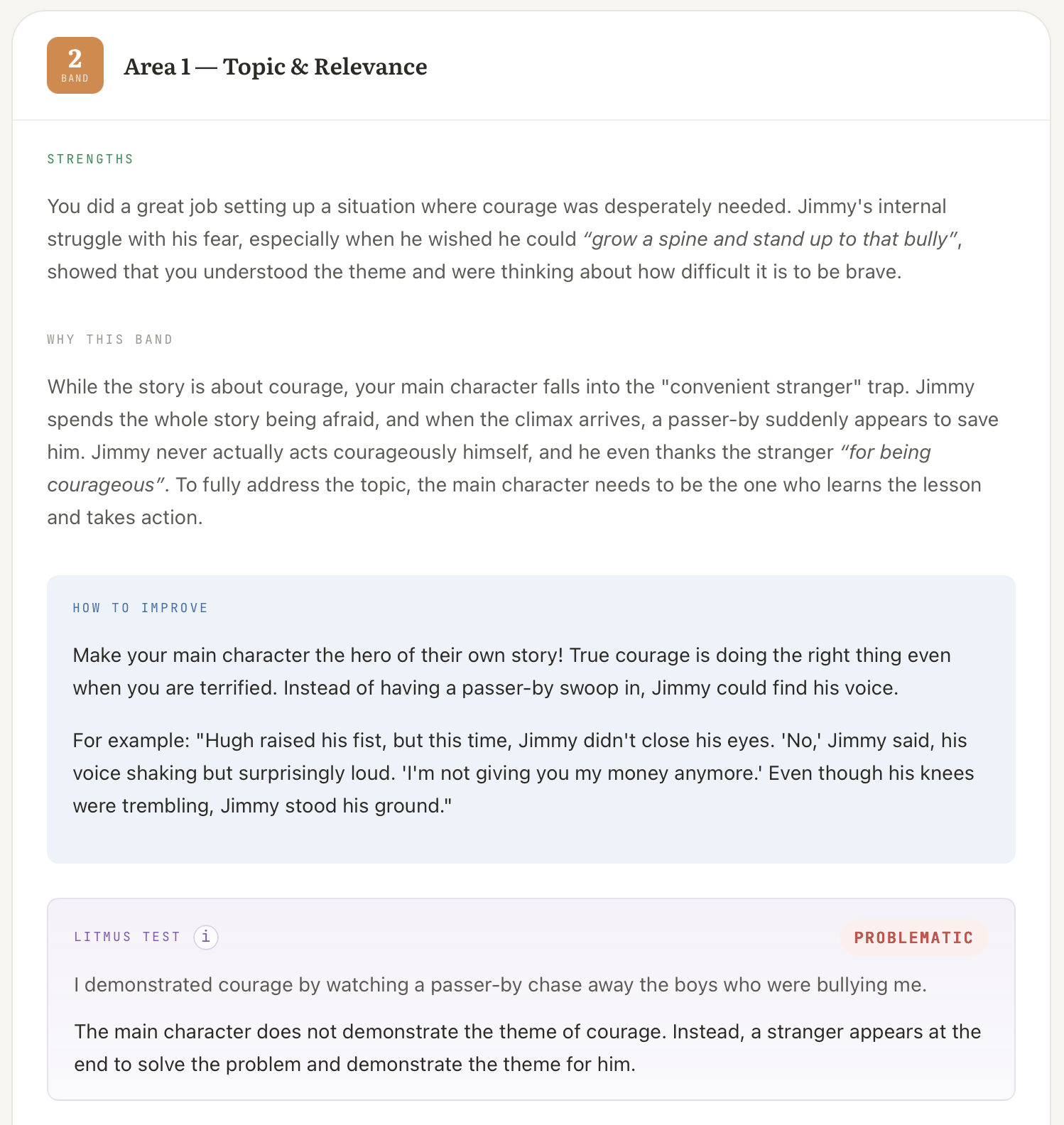
Content
2Band
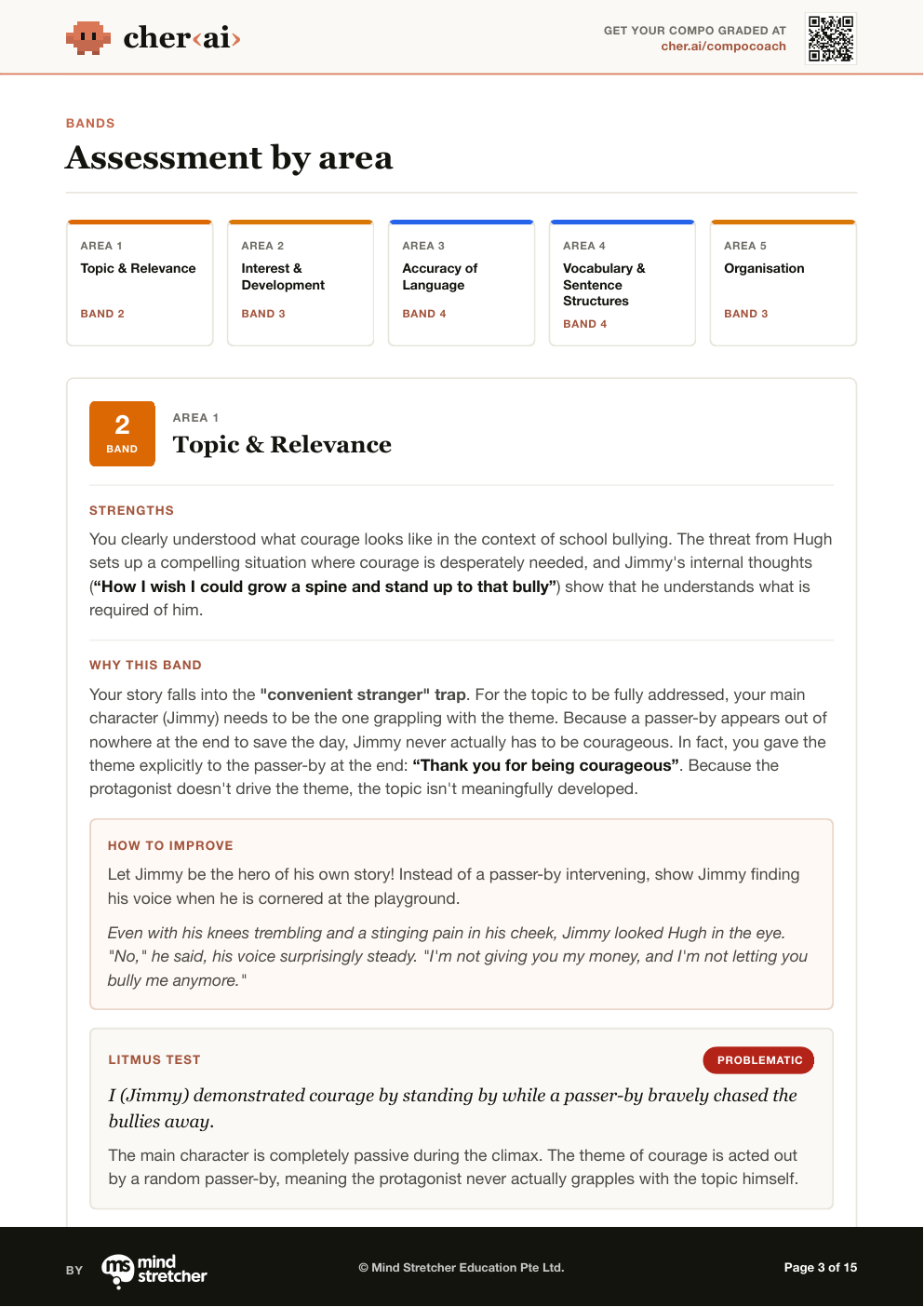
Area 1 — Topic & Relevance
Strengths

You clearly understood what courage looks like in the context of school bullying. The threat from Hugh sets up a compelling situation where courage is desperately needed, and Jimmy's internal thoughts (How I wish I could grow a spine and stand up to that bully) show that he understands what is required of him.

Why This Band

Your story falls into the "convenient stranger" trap. For the topic to be fully addressed, your main character (Jimmy) needs to be the one grappling with the theme. Because a passer-by appears out of nowhere at the end to save the day, Jimmy never actually has to be courageous. In fact, you gave the theme explicitly to the passer-by at the end: Thank you for being courageous. Because the protagonist doesn't drive the theme, the topic isn't meaningfully developed.

How to Improve

Let Jimmy be the hero of his own story! Instead of a passer-by intervening, show Jimmy finding his voice when he is cornered at the playground.

Even with his knees trembling and a stinging pain in his cheek, Jimmy looked Hugh in the eye. "No," he said, his voice surprisingly steady. "I'm not giving you my money, and I'm not letting you bully me anymore."

Litmus Test
Problematic

I (Jimmy) demonstrated courage by standing by while a passer-by bravely chased the bullies away.

The main character is completely passive during the climax. The theme of courage is acted out by a random passer-by, meaning the protagonist never actually grapples with the topic himself.

Image Integration
integral A boy standing over another boy

The image perfectly matches the climax where Hugh stands over Jimmy at the playground, slaps him, and demands the money. It effectively drives the central conflict of your story.

3Band
Area 2 — Interest & Development
Strengths

You build up excellent tension in the beginning. The scene where Hugh threatens Jimmy during recess sets clear, believable stakes (thirty dollars) and makes the reader genuinely worry about what will happen after school.

Why This Band

The climax is resolved by a coincidence—a passer-by who just happens to be watching. This makes the ending feel a bit unearned because the conflict is solved for Jimmy, not by him. Jimmy's reaction to the slap (breaking into loud wails) also makes him feel very passive right at the emotional turning point of the story.

How to Improve

Give the climax more weight by making it a real turning point for Jimmy. If he is too scared to fight back, maybe his true courage is standing his ground and refusing to cry, or deciding to sprint straight to the discipline master's office despite Hugh's threats. This gives your character a complete journey from fear to bravery.

Language & Organisation
4Band
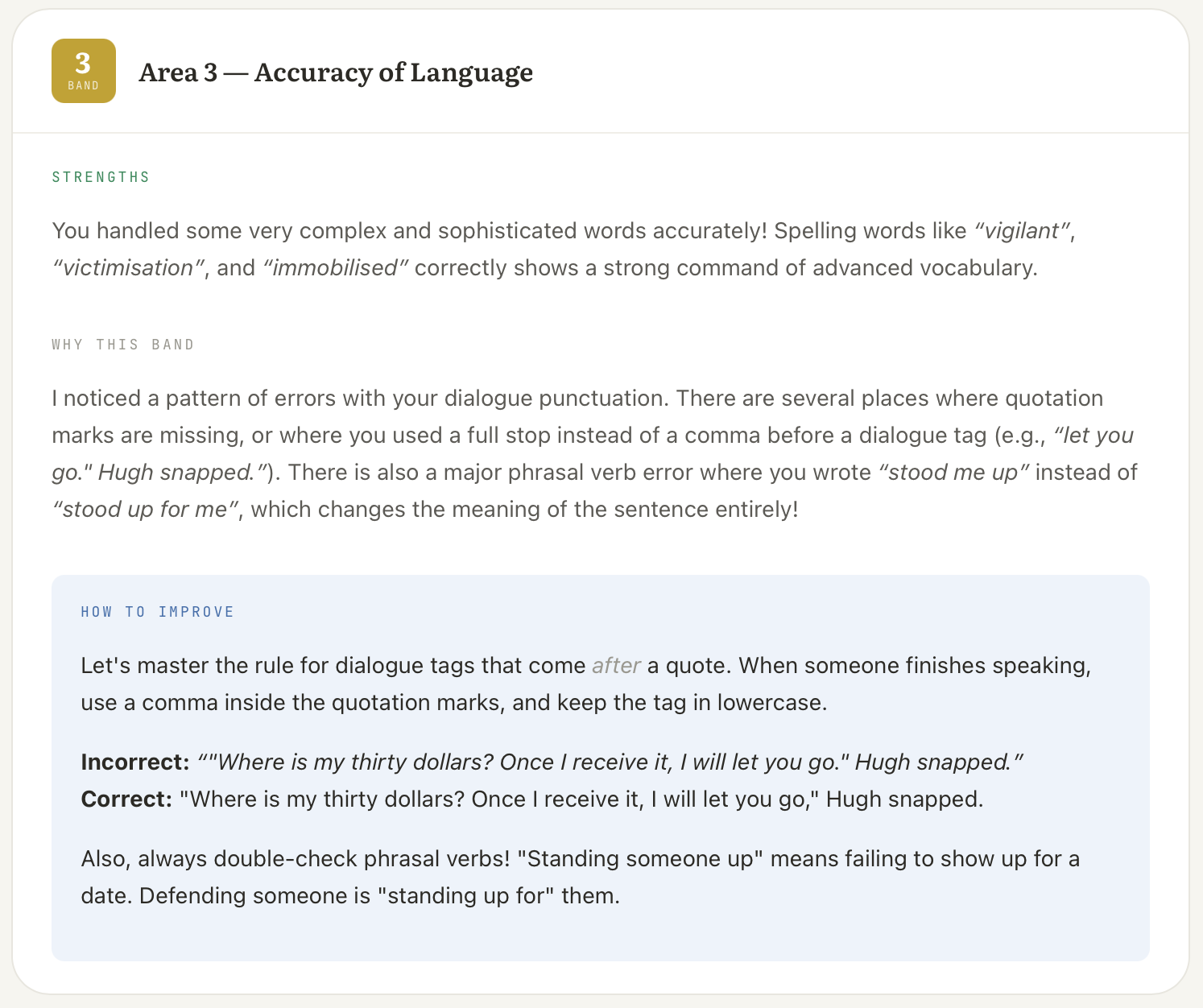
Area 3 — Accuracy of Language
Strengths

Your writing is mostly accurate, and you have strong control over your tenses. Your sentences flow well, and the few errors present do not make it difficult to follow your story.

Why This Band

You have a few dialogue punctuation errors, particularly when the dialogue tag comes after the quote (e.g., go." Hugh snapped.). You also confused the phrasal verb "stood me up" with "stood up for me", which changes the meaning of your ending completely!

How to Improve

Remember that when a dialogue tag comes after a quote, the full stop changes to a comma inside the quotation marks.

Incorrect: "Once I receive it, I will let you go." Hugh snapped. Correct: "Once I receive it, I will let you go," Hugh snapped.

Also, always double-check phrasal verbs! "Stood me up" means a friend failed to show up for a meeting, while "stood up for me" means someone protected you.

4Band
Area 4 — Vocabulary & Sentence Structures
Strengths

You used some excellent, expressive vocabulary! Phrases like raucous name-calling, stealing furtive glances, and immobilised his vocal chords paint a vivid picture and elevate your writing to a high standard.

Why This Band

While your vocabulary is strong, there are a few moments where you could use "show, don't tell" to make Jimmy's emotions even more visceral, instead of just naming his reactions (like withered there and then).

How to Improve

Instead of telling us Jimmy felt terror using abstract words, show us his physical reactions. For example, instead of terror immobilised his vocal chords, you could write:

His throat tightened, and the words he wanted to say dissolved into a dry croak.

This makes the fear feel immediate and real to the reader!

3Band
Area 5 — Organisation
Strengths

You used paragraphs to signal changes in time and scene, such as moving from recess to dismissal. Your opening drops us right into the conflict, which is a great hook that grabs the reader's attention immediately.

Why This Band

There is a sequencing error between Paragraphs 5 and 6. In Paragraph 5, Jimmy is already at the playground (He paced up and down at the playground), but the very next sentence in Paragraph 6 says, Once he reached the playground... Also, Paragraph 4 is a single sentence split awkwardly from the rest of Jimmy's continuous thought in Paragraph 5.

How to Improve

Read through your composition to check the logical flow of character movements. If Jimmy is already pacing at the playground in Paragraph 5, Paragraph 6 should focus purely on the bullies arriving:

Suddenly, three familiar shadows stretched across the sand. Jimmy's heart skipped a beat upon seeing their arrival.

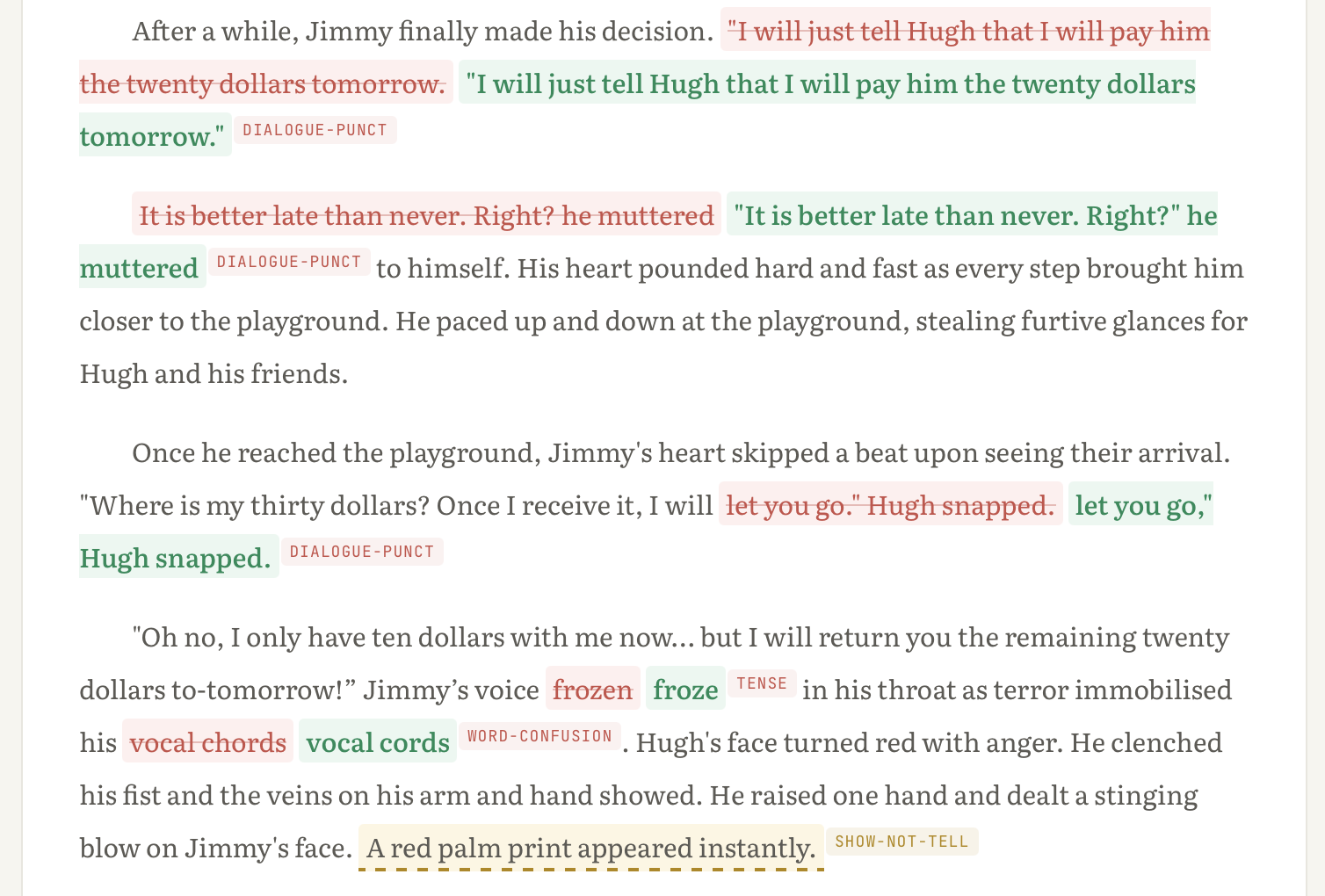
Annotated Composition — 11 errors, 3 suggestions

Your composition is shown below with grammar and language errors highlighted in red and craft improvement suggestions in amber. Hover over any highlight to see the explanation.

All 14 Dialogue-Punct 4 Spelling 2 Grammar 2 Tense 1 Phrasal-Verb 1 Punctuation 1 Suggestions 3

"There goes the Wimp! What a loser!" Hugh and his friends would call out whenever Jimmy walked by. The rest of his friends would cackle and join in the raucous name-calling. There was nothing else Jimmy could do but sigh and chide himself for not having been vigilant enough to avoid Hugh and his gang. "How I wish I could grow a spine and stand up to that bully," Jimmy muttered to himself, wondering despairingly if the victimisation would ever come to an end.

It was time for recess. Jimmy sat on his seat quietly reading a book when he suddenly saw three shadows appearing on his table that looked like Hugh and the rest of his friends. "Why must it always be me? Can't it be someone else?" Jimmy thought to himself. His head hung low in disappointment. Hugh leaned over and glared at him with bulging eyes. Baring his teeth in an ugly snarl, he hissed, "Meet me at the playground after school. Do not come without thirty dollars. Understand?" Jimmy would have withered there and thenshow-not-tell. His quickening breaths caught in his chest.

“Ringgg!” the school bell rang. It was dismissal. Jimmy remembered what Hugh had said to him during recess. "I only have ten dollars now. What if I just go back home now and pretend that nothing happened?" Jimmy muttered to himself. another Anotherpunctuation voice came in, ‘I would be dead meat tomorrow if I do not meet Hugh at the playground later, though.’ Jimmy was in a dilemma.

After a while, Jimmy finally made his decision. "I will just tell Hugh that I will pay him the twenty dollars tomorrow. tomorrow."dialogue-punct

It is better late than never. Right? he "Right?" hedialogue-punct muttered to himself. His heart pounded hard and fast as every step brought him closer to the playground. He paced up and down at the playground, stealing furtive glances for Hugh glances at Hughgrammar and his friends.

Once he reached the playground, Jimmy's heart skipped a beat upon seeing their arrival. "Where is my thirty dollars? Once I receive it, I will let you go." Hugh go," Hughdialogue-punct snapped.

"Oh no, I only have ten dollars with me now… but I will return you the remaining twenty dollars to-tomorrow!” Jimmy’s voice frozen frozetense in his throat as terror immobilised his vocal chords. Hugh's face turned red with anger. He clenched his fist and the veins on his arm and hand showed. He raised one hand and dealt a stinging blow on Jimmy's face. A red palm print appeared instantly.

"Ouch!" Jimmy holwed howledspelling in pain. His eyes reddened and turned moist. He broke out into loud uncontrollable sobs which escalated into wails.

Little did they know there had been a passer-by who had watched the whole entire scenesentence-variety. She was completely bewildered by the sight. "Hey! Stop what you are doing now before I report this incident to your teachers!" bellowed the passer-by.

Hugh and his friends blinked continuously and stopped whatever they were doing. The passer-by unblinking passer-by's unblinkinggrammar eyes flashed with anger. "What are you doing to the poor boy? People your age should not be bullying others. Instead, you should go home and focus on your studies! Now, go home and leave this boy alone!" she snapped.

The three boys lowered their eyes and scampered off. After seeing them gone, Jimmy heaved a sigh of relief and could breathe more easily. "Are you ok ay okayspelling? Your face seems very red." the red," thedialogue-punct passer-by questioned. "Yes, I am all right, all thanks to you. If you had not stood me up stood up for mephrasal-verb, I wonder what they would do to me! Thank you for being courageousword-choice and your help!" Jimmy said.

Generated by CompoCoach

Aligned with the 2025 PSLE English marking rubrics

Current rubric standards for Continuous Writing

Band Mark Range Criteria
5 16–18
  • Fully relevant
  • Highly interesting and thoroughly-developed composition
4 13–15
  • Relevant
  • Interesting and well-developed composition
3 9–12
  • Generally relevant
  • Fairly interesting and sufficiently-developed composition
2 5–8
  • Some relevance
  • Some attempt to be interesting and composition is minimally developed
1 1–4
  • A slight attempt to address the topic
  • A slight attempt to develop composition
Band Mark Range Criteria
5 16–18
  • Grammar, expression, spelling and punctuation are used accurately
  • Wide range of vocabulary and structures appropriately used
  • Very good sequencing, paragraphing and linking of ideas
4 13–15
  • Grammar, expression, spelling and punctuation are mostly accurate
  • Adequate range of vocabulary and structures used mostly appropriately
  • Good sequencing, paragraphing and linking of ideas
3 9–12
  • Grammar, expression, spelling and punctuation are used with some accuracy
  • Fairly adequate range of vocabulary and structures
  • Fairly good sequencing, paragraphing and linking of ideas
2 5–8
  • Grammar, expression, spelling and punctuation are used with varying degrees of accuracy; meaning is generally clear
  • Mostly simple vocabulary and structures
  • Some attempt at sequencing, paragraphing and linking of ideas
1 1–4
  • A few instances of correct use of grammar, expression, spelling and punctuation
  • A few instances of simple vocabulary and structures
  • A slight attempt at sequencing, paragraphing and linking of ideas